
The Definitive Engineering Manual on Precision Ducted AC Installation Across Dubai
Master the complexities of central climate control setup, static pressure duct design, and tropicalized mechanical integration with professional guidelines dedicated to flawless ducted ac installation for elite residential and commercial properties.
The Ultimate Master Manual on Central Climate Engineering, Ductwork Aerodynamics, Refrigerant Circuitry, and Executing Flawless Ducted AC Installation in Dubai and the UAE
The architectural landscape of the United Arab Emirates is defined by extraordinary luxury villas, expansive master-planned suburban developments, modern commercial headquarters, and high-end hospitality estates. In an environment where ambient summer temperatures soar past extreme thresholds, maintaining precise indoor comfort, acoustic serenity, and pristine air quality is an absolute necessity. While purchasing high-end central cooling hardware is a critical first step, the ultimate performance, energy efficiency, and operational lifespan of your climate control system depend entirely on the precision, rigor, and technical expertise applied during ducted ac installation.
Throughout this exhaustive and meticulously detailed engineering manual, we will take you on an in-depth journey through every phase of central air conditioning setup. We will explore thermodynamic load calculations, ductwork aerodynamics, static pressure balancing, copper refrigerant line brazing, insulation integrity, and condensate drainage engineering. Whether you are managing a new construction project in an elite golf estate, retrofitting a sprawling courtyard villa, or outfitting a commercial office building, understanding the rigorous standards required for professional ducted ac installation ensures that your investment delivers uncompromised, whisper-quiet performance for decades to come.
1. The Critical Significance of Professional Engineering in Ducted AC Installation
Air conditioning installation—particularly when dealing with concealed central ducted systems—is a sophisticated mechanical engineering discipline that bears zero resemblance to hanging a standard wall-mounted split unit. A ducted system functions as an integrated, closed-loop thermal circulatory network comprising an outdoor condensing unit, an indoor fan coil unit, high-pressure copper refrigerant piping, electrical control wiring, plenum boxes, and an extensive network of supply and return air ducts.
Attempting to cut corners during ducted ac installation or hiring unqualified contractors leads directly to a cascade of catastrophic failures, including severe cooling imbalances, whistling aerodynamic noises, water condensation damage on false ceilings, compressor burnout, and exorbitant electricity bills. Professional execution ensures that every mechanical component operates in perfect harmony with the architectural structure of the building, maximizing thermal efficiency while safeguarding indoor air quality.
2. Phase One: Comprehensive Cooling Load Calculations and Site Surveys
Before a single meter of ducting is fabricated or any equipment is positioned, a successful ducted ac installation begins with meticulous engineering design. Every building possesses unique thermal load characteristics based on its architectural orientation, window glazing coefficients, wall and roof insulation values, lighting density, and human occupancy.
Thermal Heat Gain Analysis
Certified HVAC engineers perform detailed heat load calculations (measured in British Thermal Units per hour or Tons of Refrigeration) for every individual room. South-facing glass facades and expansive double-height ceilings introduce massive solar thermal gains that require precise adjustments in air delivery volume. Accurate calculations prevent equipment oversizing—which causes short-cycling, high humidity, and rapid mechanical wear—as well as undersizing, which forces compressors to run continuously at maximum stress with zero thermal reserve.
Equipment Sizing and Static Pressure Planning
Once total heat loads are established, engineers select indoor fan coil units and outdoor condensing units matched precisely to the building’s requirements. Furthermore, external static pressure (ESP) calculations are performed to determine the fan motor capacity needed to push conditioned air through long duct runs, elbows, filters, and supply diffusers without losing air velocity.
3. Phase Two: Ductwork Fabrication, Aerodynamics, and Air Distribution
The duct network acts as the respiratory system of your building during ducted ac installation. The design, material selection, and fabrication quality of the ductwork dictate whether your home enjoys silent, balanced cooling or suffers from noisy, uneven temperature zones.
Duct Material Selection and Insulation
High-quality galvanized iron (GI) sheet metal or pre-insulated phenolic foam boards are utilized to fabricate rigid supply and return air ducts. In Dubai’s humid climate, thermal insulation is paramount. All supply ducts must be wrapped in high-density closed-cell elastomeric foam insulation or faced with heavy vapor barriers to prevent thermal transfer and condensation sweating within false ceilings.
Preventing Static Pressure Losses
Flawless ducted ac installation requires strict adherence to aerodynamic principles. Sharp ninety-degree bends without turning vanes, sudden transitions in duct diameter, and loose slip joints create severe turbulence and pressure drops. Professional installers utilize smooth radius elbows, splitter dampers for air balancing, and airtight mastic sealant on all longitudinal and transverse seams to ensure zero air leakage.
Aesthetic Integration and Air Diffusion
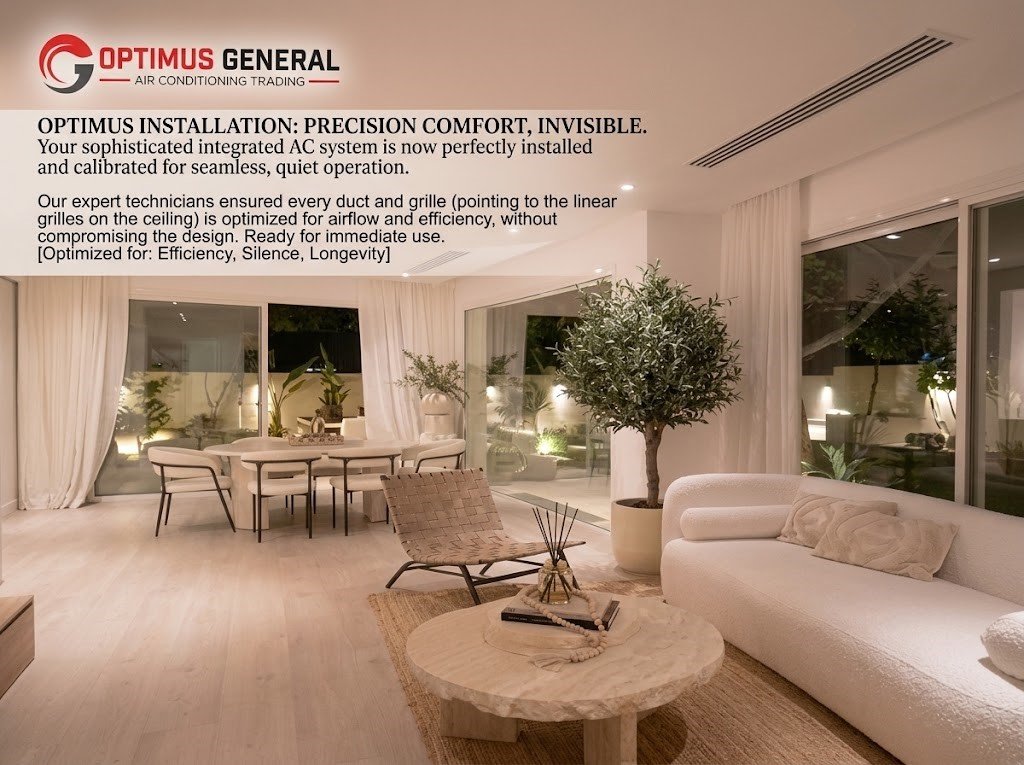
Rigorous ducted ac installation ensures that bulky machinery is entirely concealed within ceiling voids, leaving only elegant linear slot diffusers and return grilles visible while flooding interiors with silent, balanced airflow.
4. Phase Three: Refrigerant Piping, Brazing, and Insulation Integrity
The refrigerant circuit connects the outdoor condensing unit to the indoor ducted fan coil, serving as the circulatory pathway for thermal energy transfer. Executing this phase of ducted ac installation requires certified brazing technicians and strict adherence to manufacturer specifications.
Nitrogen Purging During Brazing
When joining copper refrigerant lines, dry nitrogen gas must be purged through the copper tubing at a controlled low pressure while torch brazing is performed. Without nitrogen purging, oxygen inside the hot copper pipe reacts to form internal copper oxide scale flakes. Over time, these flakes break loose, circulate through the system, and clog expansion valves or ruin compressor bearings.
Vapor Line Insulation and Wall Penetrations
The suction (vapor) line carries cold low-pressure refrigerant and is highly susceptible to condensation in hot, humid environments. Comprehensive ducted ac installation mandates that suction lines are encased in thick, continuous closed-cell elastomeric insulation without exposed joints or compression flatteners where wall penetrations occur.
5. Phase Four: Condensate Drainage Engineering
During the cooling and dehumidification process, air conditioners extract substantial volumes of moisture from indoor air. This water collects in the indoor unit’s drain pan and must be safely evacuated outside the building. Improper drainage execution during ducted ac installation is the leading cause of costly ceiling water damage in residential and commercial properties.
- Consistent Downward Slope: Drain pipes must maintain a strict, continuous downward gradient of at least one centimeter per meter to prevent water pooling.
- Proper U-Traps: A primed U-trap must be installed immediately after the indoor unit’s drain connection to prevent foul sewer gases and insects from entering the living space via the drain line.
- Secondary Emergency Drain Lines: Professional ducted ac installation always incorporates a secondary overflow drain connected to a visible exterior discharge point, providing immediate warning if the primary drain clogs.
6. Phase Five: Electrical Wiring, Controls, and System Commissioning
The final mechanical phase of ducted ac installation involves integrating heavy-duty power supplies, low-voltage control wiring, thermostats, and smart zoning dampers.
Electrical Safety and Overcurrent Protection
Central ducted units draw substantial electrical current, particularly during compressor startup. Dedicated power supply cables sized in accordance with local electrical codes must be run from dedicated circuit breakers in the main distribution board to weatherproof outdoor isolator switches and indoor fan coil units.
System Evacuation and Pressure Testing
Before releasing refrigerant into the newly installed copper circuit, technicians must perform a rigorous pressure test using dry nitrogen to verify joint integrity. Following a successful pressure hold test, a high-vacuum pump must be connected to evacuate all moisture and non-condensable gases down to a deep vacuum level (below 500 microns). Skipping this evacuation step during ducted ac installation leads to acid formation, oil degradation, and compressor failure.
7. Post-Installation Testing, Balancing, and Commissioning
Once mechanical and electrical work is completed, the system undergoes comprehensive commissioning. Technicians measure operating pressures, superheat and subcooling metrics, electrical amperage draw, and airflow velocity at every supply diffuser. Balancing dampers are adjusted to ensure every room receives its precise design airflow rate, completing a successful ducted ac installation.
8. Conclusion: Securing Long-Term Performance Through Expert Installation
Investing in elite central cooling hardware is only half the equation. Ensuring that your system is executed by certified professionals specializing in advanced ducted ac installation guarantees uncompromised energy efficiency, whisper-quiet operation, and absolute peace of mind for decades to come.
Leave a Reply